All work

OnZero

AI character & brand studio

A creation platform built on DNA-locked characters: define an identity once, and every image and video after it keeps the same face - wrapped in a full production pipeline.

Role
Product · UX/UI · Full-stack
Type
AI · Creative tooling
Core
DNA-locked identity
Surface
Web app · MCP tooling

What it is

The failure mode of generative tooling in a brand context is consistency. Generate a character twice and you get two people; restate a palette on every asset and it drifts; let a model draw a logo and it warps.

OnZero answers each of those with a structural rule rather than a better prompt: identity is locked in the character, brand is applied by reference, and logos are composited deterministically after generation.

The problem

  • Identity drifts - Generate the same character twice and you get two different people
  • Brand is restated every time - Palette, logo and tone re-entered on every asset
  • Logos get mangled - Generative models redraw them and they warp
  • One size, one design - Resizing a design regenerates a different one

The solution

  • Character DNA - One locked identity, infinite scenes
  • Brand kits - Palette, art direction and rules applied by id
  • Deterministic logos - Composited after generation, never drawn
  • Adapt, don't regenerate - One master, reflowed to every size

How it's built

Identity
Character DNA
Reference image + locked attributes
same face across every render
Brand
Brand kits
Palette · art direction · voice
applied by brandId
Assets
Reusable library
Logos, products, mascots
passed as references
Pipeline
Post-processing
Matting · upscaling
size adaptation · image-to-video
15generation models behind one interface
4modalities: image, video, voice, music
2Kdefault render resolution

The screens

Positioning

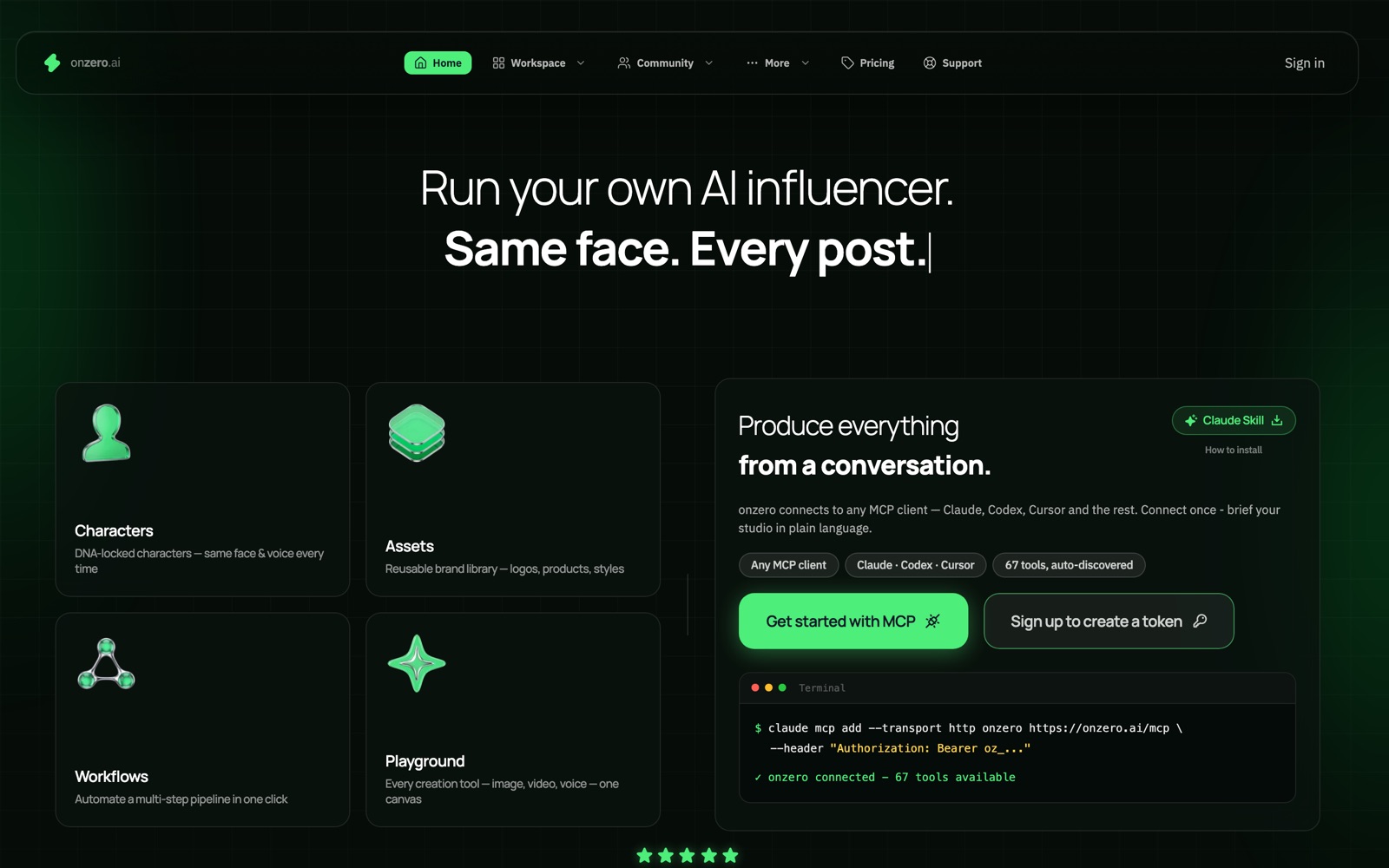
The promise is stated as a constraint, not a feature: “Same face. Every post.” That single line names the failure mode of every other generative tool and claims the fix. Below it the four primitives - characters, assets, workflows, playground - and a terminal block showing the platform connecting to any MCP client, because a real part of the audience wants to drive it from their editor rather than a UI.
OnZero - Positioning

Community

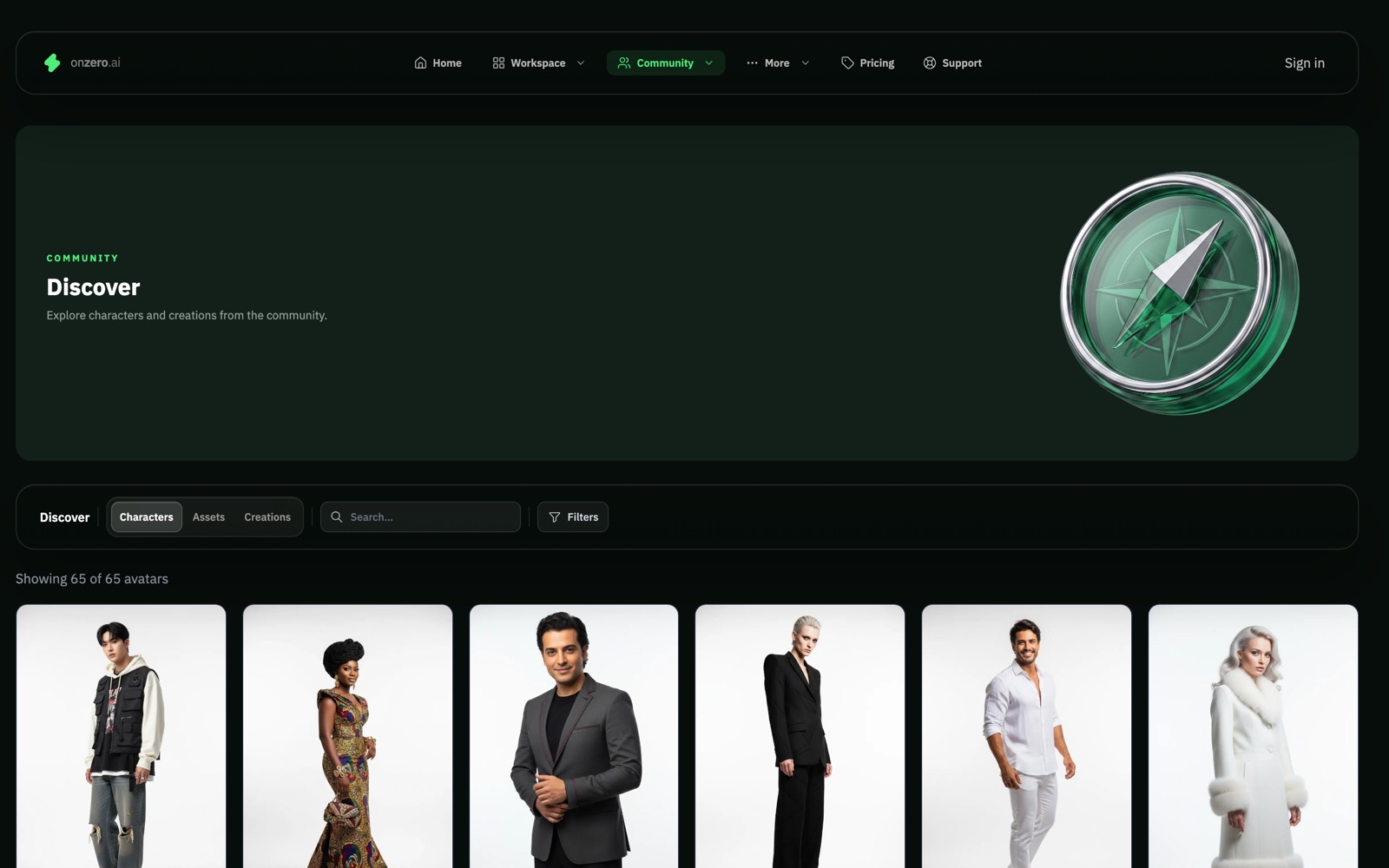
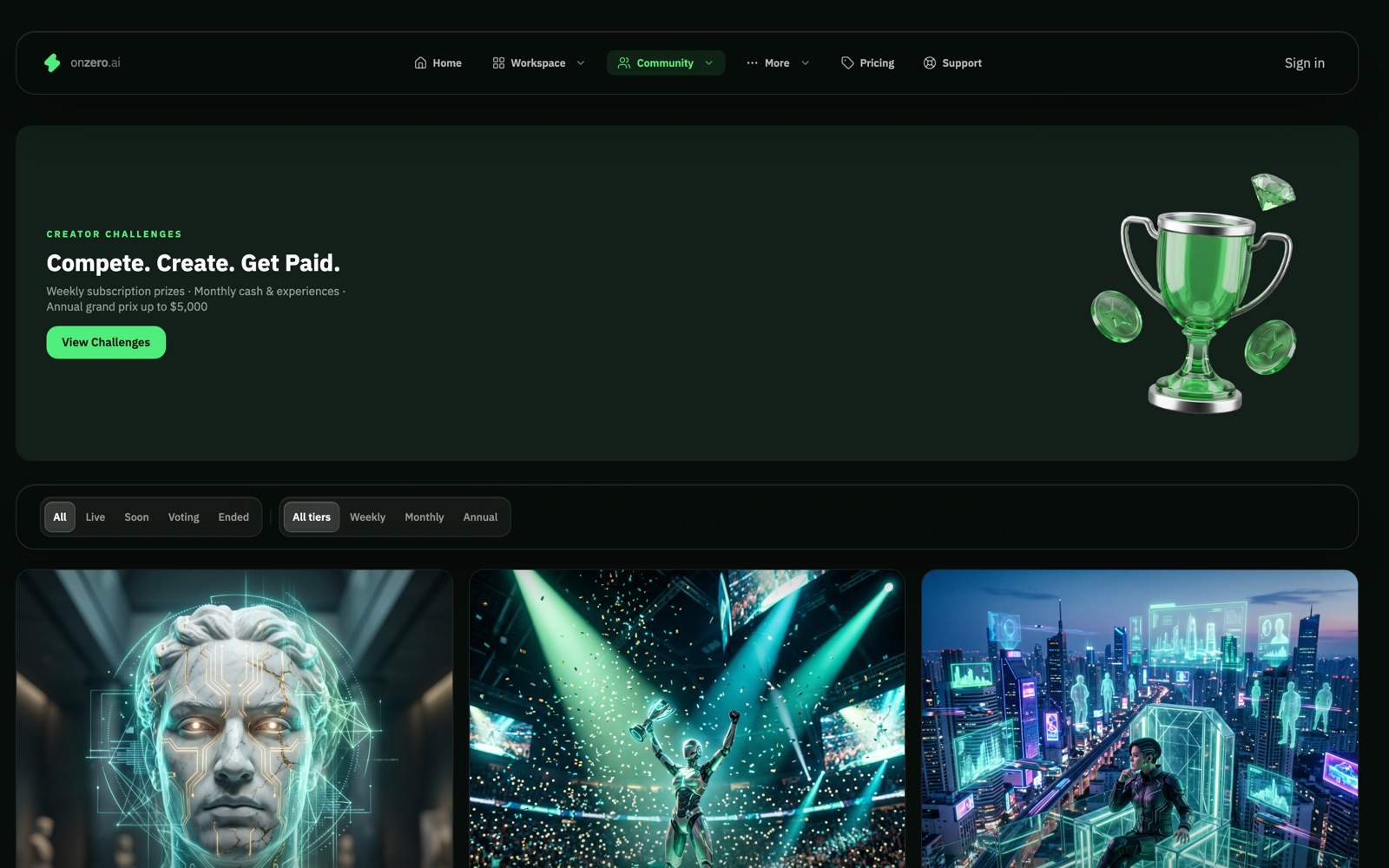
The library is the proof. Discover shows characters and creations from the community - every avatar rendered from a locked identity, which is the argument made visually rather than in copy. Challenges turn that into a loop: a themed brief, public entries and a leaderboard, so the platform has a reason to be opened on a day when nobody has a campaign to make.
OnZero - Community
OnZero - Community

Business model

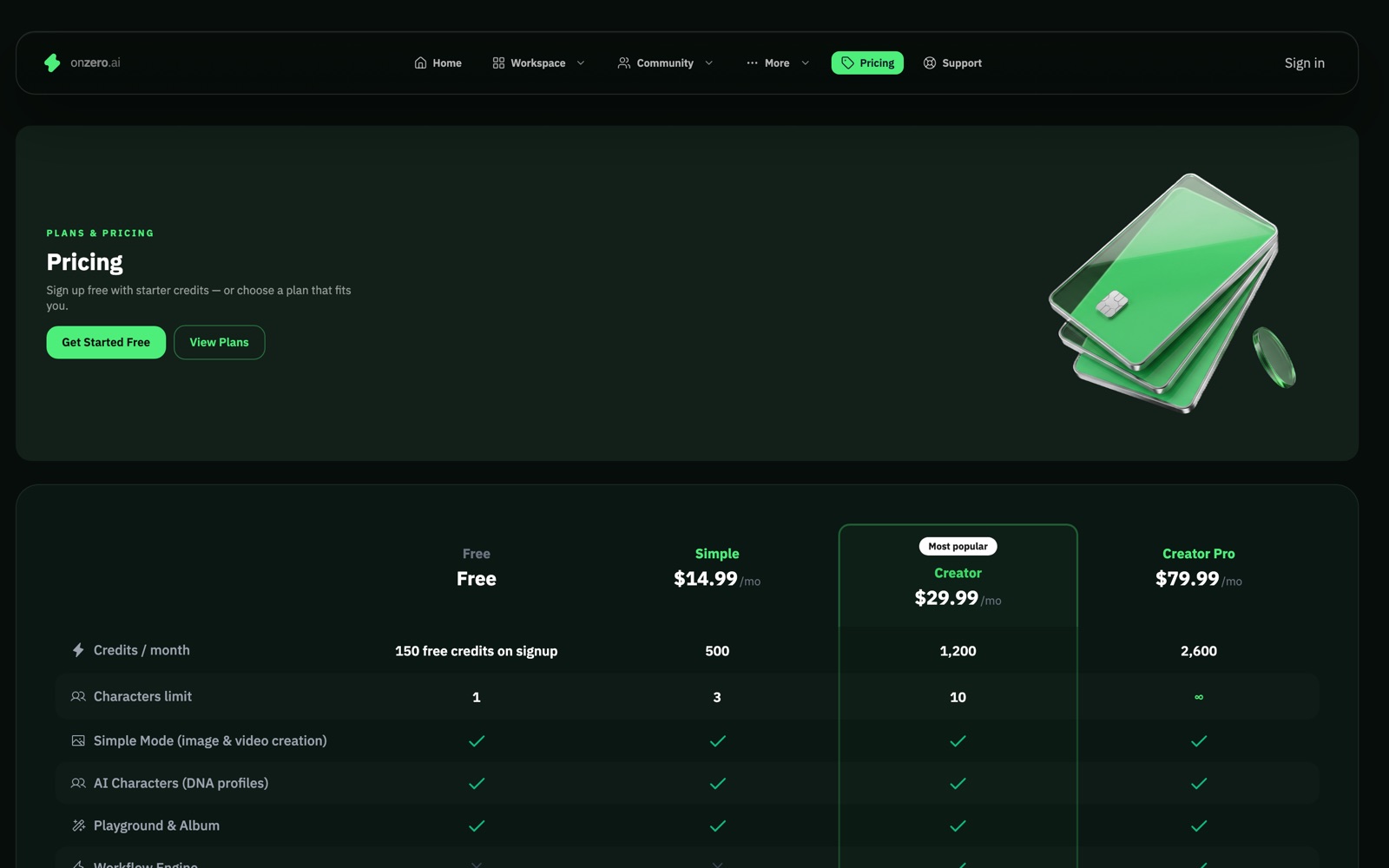
Generation costs money per call, so the model is credits rather than seats. Pricing has to make an unfamiliar unit legible - what a credit buys, and what a month of real use actually costs - which is a copy problem as much as a layout one.
OnZero - Business model

Identity lock in practice

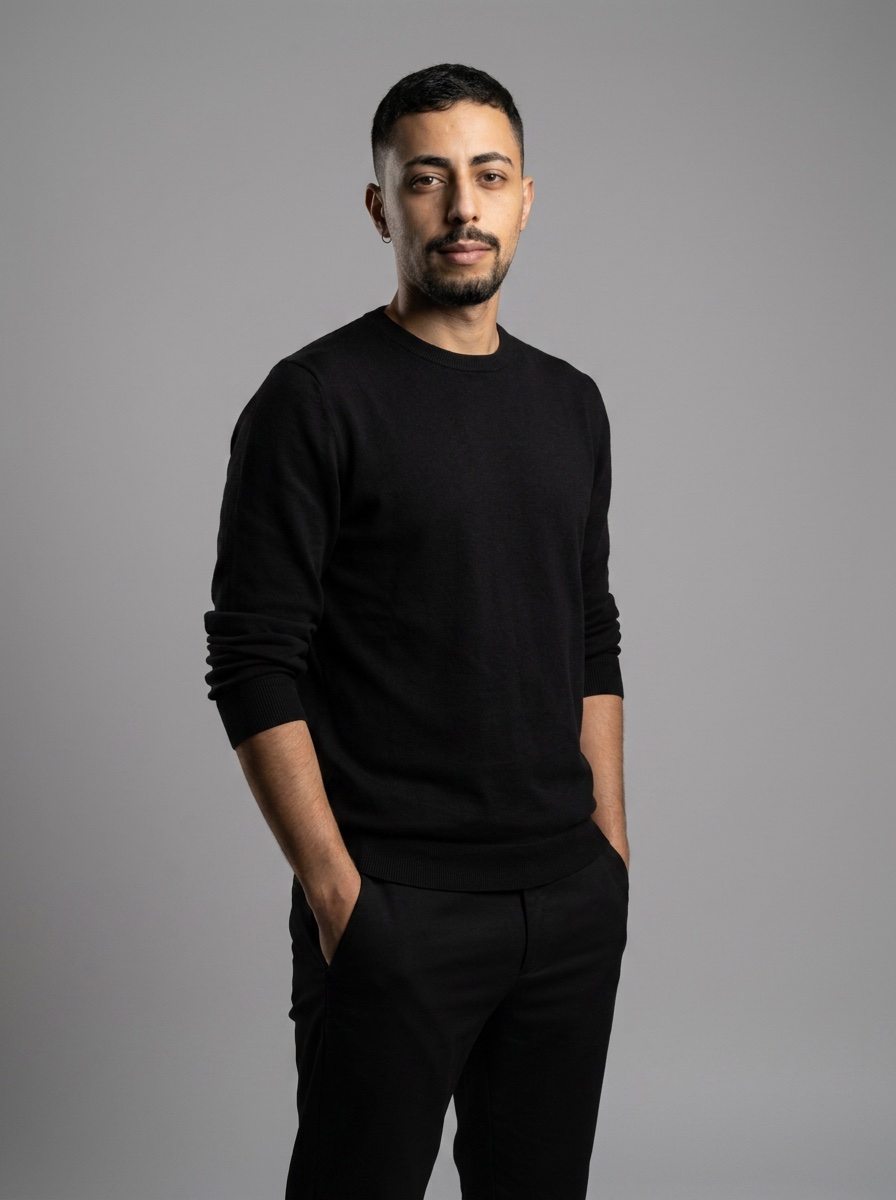
The portrait in this site's hero was produced with OnZero from a DNA-locked character, then cut out with the platform's own matting rather than a prompt for a white background. That's the whole argument in one asset: the same face, on demand, in any scene - and a production-grade cutout to composite with.
OnZero - Identity lock in practice

Design decisions

01

  • Identity as a structure, not a prompt - Consistency can't be requested politely from a model. It has to be enforced by the system - which is what the character DNA does.

02

  • Never let a model draw the logo - Generative models re-synthesise every pixel. The real logo file is composited after generation, pixel-perfect.

03

  • One master, then adapt - Regenerating per size silently produces a different design. Generating once and reflowing keeps a campaign coherent.

04

  • The right tool, not the closest one - A small change is an edit, not a regeneration. A cutout is matting, not a prompt. The platform makes that distinction explicit.

05

  • Ask before generating - Generation costs credits and time. The tooling is designed to settle model, ratio and copy first.

06

  • Tooling as an interface - The platform is exposed as MCP tools, so it can be driven conversationally as well as through the UI.
Next project
Doodi →
Get in touch